

Roundtable
Regional Approaches
to Biorisk Management and Preparedness for Emerging and High-Consequence Diseases

A multidisciplinary discussion connecting animal-disease epidemiology, field prevention, biosafety, biosecurity, applied risk assessment, and the verification of high-containment laboratory systems.
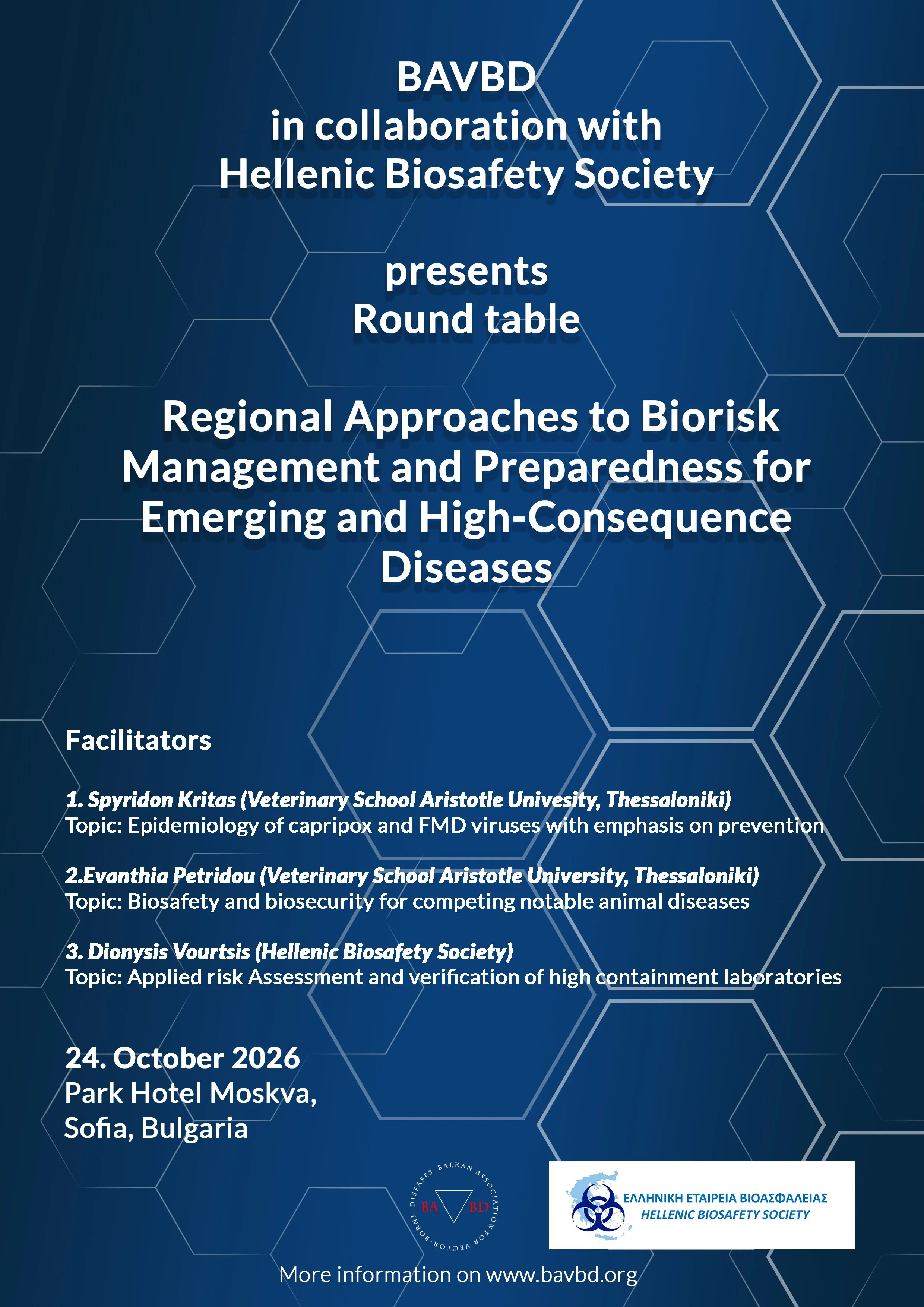
Roundtable overview
Emerging and high-consequence diseases can place animal health, public health, food production, trade, laboratory personnel, and regional preparedness systems under substantial pressure.
Effective preparedness requires more than expertise in individual pathogens. It depends on coordinated surveillance, rapid detection, evidence-based prevention, laboratory biosafety, biosecurity, risk-informed decision-making, reliable containment systems, and effective communication between neighboring countries.
This roundtable will bring together specialists in veterinary infectious diseases, veterinary microbiology, biosafety, biosecurity, and laboratory risk management to examine how regional capacities can be strengthened across the Balkans and neighboring regions.
The discussion will connect three operational levels:
Prevention and control of transboundary animal diseases
Biosafety and biosecurity for notifiable disease preparedness
Risk assessment and verification of high-containment laboratories
Why this roundtable matter?
Biological threats do not stop at national borders. Disease preparedness therefore depends on the ability of veterinary services, diagnostic laboratories, research institutions, biosafety professionals, public health authorities, and decision-makers to work within a shared regional framework.
The roundtable will examine how scientific evidence can be translated into practical preparedness measures—from prevention at farm and field level to the safe handling of biological material and the verification of laboratory containment performance.
Roundtable objectives
Participants will:
Examine the epidemiology and prevention priorities associated with capripoxviruses and foot-and-mouth disease virus.
Consider how biosafety and biosecurity principles can support the control of notifiable animal diseases.
Explore practical approaches to biological risk assessment in diagnostic, veterinary, research, and high-containment facilities.
Discuss how laboratory containment measures should be tested, documented, and verified.
Identify opportunities for regional training, information exchange, preparedness exercises, and cross-border cooperation.
Consider how One Health collaboration can improve readiness for emerging and high-consequence diseases.
Speakers and presentations
Prof. Spyridon Kritas
Professor, Laboratory of Microbiology and Infectious Diseases
School of Veterinary Medicine, Aristotle University of Thessaloniki, Greece
Epidemiology of Capripoxviruses and Foot-and-Mouth Disease Virus, with Emphasis on Prevention
Prof. Spyridon Kritas will examine the epidemiological characteristics of capripoxvirus infections and foot-and-mouth disease, with particular emphasis on prevention and preparedness.
The presentation will consider surveillance, pathways of disease introduction and spread, early recognition, field biosecurity, vaccination strategies, communication with animal-health professionals and producers, and the importance of coordinated regional control measures.
Prof. Kritas is affiliated with the Laboratory of Microbiology and Infectious Diseases at the School of Veterinary Medicine, Aristotle University of Thessaloniki, and his professional profile includes veterinary infectious-disease epidemiology, prevention, vaccination, and emerging infections.
Prof. Evanthia Petridou
Professor, Faculty of Veterinary Medicine
Aristotle University of Thessaloniki, Greece
Biosafety and Biosecurity for Combating Notifiable Animal Diseases
Prof. Evanthia Petridou will address how biosafety and biosecurity measures can support the prevention, diagnosis, and control of notifiable animal diseases.
Her presentation will examine the translation of biorisk-management principles into operational practice, including safe specimen handling, personnel protection, laboratory procedures, quality management, facility controls, biological-material security, and coordination between laboratories and veterinary authorities.
Prof. Petridou has more than 20 years of teaching experience in microbiology and infectious diseases. She is an IFBA-certified professional in biorisk, has contributed to biosafety educational resources for animal production, serves as a quality manager in an accredited testing laboratory, and supervises the European College of Veterinary Microbiology training centre at Aristotle University of Thessaloniki
Dionysis Vourtsis, PhD
Biorisk Management Advisor
President, Hellenic Biosafety Society · Athens, Greece
Applied Risk Assessment and Verification of High-Containment Laboratories
Dr. Dionysis Vourtsis will focus on the practical application of biological risk assessment and the methods used to verify whether high-containment laboratories perform as intended.
The presentation will address the relationship between hazard identification, procedural analysis, engineering controls, administrative controls, personal protective equipment, staff competence, emergency preparedness, maintenance, documentation, and performance verification.
Particular attention will be given to moving beyond nominal containment classifications toward evidence-based verification of operational readiness and continuous improvement.
Dr. Vourtsis works in biosafety, biosecurity, and biorisk management and serves as President of the Hellenic Biosafety Society. His professional activities include biological risk assessment, laboratory preparedness, professional education, and the advancement of biosafety and biosecurity capacity in the Balkan region.
Key discussion themes
-
What minimum capabilities should countries maintain for the early detection, containment, and management of emerging and high-consequence animal diseases?
-
How can surveillance, vaccination, farm-level biosecurity, laboratory preparedness, and risk communication be better connected before an outbreak occurs?
-
How can international principles and standards be translated into realistic procedures for veterinary, diagnostic, public health, and research laboratories?
-
What evidence is required to demonstrate that a high-containment facility, its equipment, procedures, and personnel are operating safely and effectively?
-
How can countries improve the timely exchange of epidemiological information, laboratory findings, biological-risk alerts, and lessons learned?
-
Which regional training programs, simulation exercises, professional networks, and verification mechanisms could deliver the greatest long-term benefit?
Expected outcomes
The roundtable is intended to support:
A clearer understanding of the relationship between disease epidemiology and biorisk management.
Greater alignment between field prevention and laboratory preparedness.
Improved awareness of risk-based biosafety and biosecurity practices.
Better understanding of high-containment laboratory verification.
Identification of regional capacity gaps and training needs.
New opportunities for collaboration between veterinary, laboratory, biosafety, and public health professionals.
Practical recommendations for future BAVBD activities and regional initiatives.
Who should attend?
This roundtable will be particularly relevant to:
Veterinarians and veterinary epidemiologists
Veterinary microbiologists and virologists
Diagnostic and reference-laboratory personnel
Biosafety officers and biorisk-management advisors
Public health and One Health professionals
Animal-health authorities and regulatory representatives
Laboratory managers and quality managers
Researchers working with high-consequence pathogens
Emergency-preparedness and outbreak-response professionals
Professionals responsible for high-containment facilities
Policy-makers and institutional decision-makers